Five Hidden Mirrors in World Literature
Introduction
Imagine that every book ever written—from ancient epics to modern poems—is made of the same set of building blocks, like a giant box of Lego bricks. Most of us read for the story or the emotion, but if you look closer at the letters themselves, a hidden world of “perfect matches” begins to appear. This essay explores a series of five remarkable discoveries where lines from completely different centuries and authors are actually “twins.” By rearranging the letters of a 20th-century English poem, we find that they spell out, letter-for-letter, a 13th-century French romance or a Roman war epic.
These are not just random coincidences. When we look at pairs like a “Good King” matching a “Singing Lady,” or a “Bitter Tongue” matching a “Bold Warrior,” we see a strange symmetry at work. It is as if the English language has a “hard-coded” DNA for certain themes. Whether an author is writing about a quiet Scottish forest or the blinding heat of a factory, they are using the exact same “alphabetical energy.” By uncovering these five anagrams, we aren’t just looking at word games; we are finding a secret bridge that connects all writers across history, proving that literature is one big, interconnected puzzle waiting to be solved.
The King and the Singer: The Crown and the Chorus (A 700-Year-Old Literary Mirror)
“That ruled once on a time;” → “Et une dame lor chantoit,”
Our journey into this hidden linguistic architecture begins in the quiet shade of an orchard, where two figures—separated by seven hundred years and the English Channel—share a single, secret identity.
The first figure comes to us from the twentieth-century imagination of G.K. Chesterton. He introduces us to a “good king” who “ruled once on a time;” a phrase that carries the heavy, rhythmic heartbeat of history and earthly power. But when we dismantle that very line and scatter its twenty letters like seeds, a strange transformation occurs. Those exact same letters, without a single one added or removed, rearrange themselves into the elegant Old French of the thirteenth century: “Et une dame lor chantoit,” or “And a lady sang to them.”
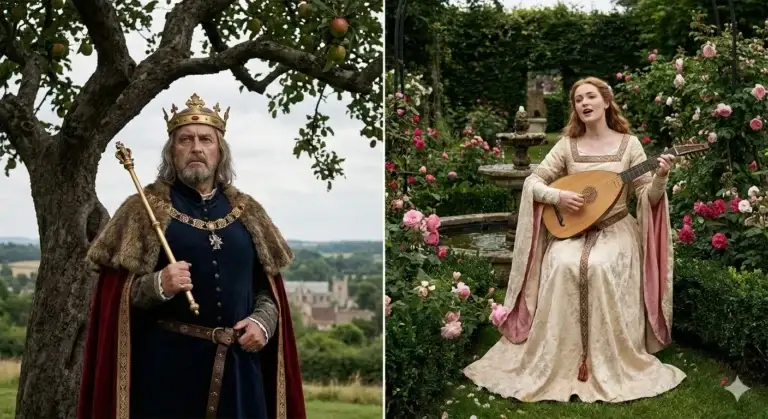
This is more than a clever trick of the alphabet; it is a revelation of balance. On one side of the mirror, we have the King—the symbol of Order, Law, and the physical world. On the other, we have the Lady—the symbol of Harmony, Art, and the spiritual world. While the King “rules” the land, the Lady “sings” to the soul.
What makes this discovery truly breathtaking is the setting they share. Both are anchored in the ancient “Garden” of literature. Chesterton’s king stands by an apple tree, while the lady in The Romance of the Rose enchants a garden of delights. The anagram tells us that these two figures are actually two halves of the same whole. It suggests that true leadership and beautiful music are built from the same “matter.” One provides the structure of the world, and the other provides its song. In the grand puzzle of language, the King and the Lady are not strangers; they are the same energy, singing and ruling across the ages.
From Yeats to Virgil: The Sword and the Spite (The Anagram of Human Conflict)
“Where I must hear all day a bitter tongue,” → ” With greater ease the bold Rutulian may,”
As we move from the serene gardens of kings and singers, the “alphabetical energy” of our discovery shifts into something sharper and more electric. Our second revelation bridges the gap between the weary streets of twentieth-century Dublin and the blood-soaked battlefields of ancient Rome.
On one hand, we have the great Irish poet W.B. Yeats, who in his poem The People, laments the exhaustion of public life with the stinging line: “Where I must hear all day a bitter tongue,”. It is a phrase that tastes of salt and fatigue—the sound of endless criticism and social friction. Yet, when we take these thirty-three letters and cast them into the crucible of history, they emerge as a line from John Dryden’s legendary translation of Virgil’s Aeneid: “With greater ease the bold Rutulian may,”.

The contrast is nothing short of spectacular. Yeats gives us the passive suffering of the modern man, trapped in a room with a “bitter tongue.” Virgil gives us the active power of the “bold Rutulian” warrior, Turnus, moving with “greater ease” toward combat.
What the anagram whispers to us is a profound psychological truth: the energy of the warrior and the energy of the critic are identical. The “boldness” of the ancient soldier has not disappeared; it has merely been rearranged into the “bitterness” of the modern speaker. The “ease” with which the warrior attacks is the very thing that creates the “must” (the obligation and burden) for the poet.
Through this thirty-three-letter mirror, we see that conflict hasn’t changed—only its weapon has. Whether it is a bronze sword in Italy or a sharp remark in an Irish theater, the “matter” of human strife remains the same. The letters prove that the “Bitter Tongue” is simply the “Bold Warrior” in a different mask, haunting the poet just as the soldier haunted the hero.
The Furnace and the Forest: Industrial Heat vs. Highland Mist (Alchemy in Verse)
“Were smelted up in the blinding heat” → ” And mingled with the pine-trees blue”
Our journey now takes us into the heart of transformation itself, where the violent heat of industry meets the cool mist of the wilderness. This third discovery is perhaps the most visceral, as it links the “blinding” light of a modern furnace with the “blue” shadows of a Scottish highland.
From the gritty, industrial landscape of Edgar Lee Masters’ Spoon River Anthology, we are given a line of total destruction: “Were smelted up in the blinding heat”. It is a phrase that smells of iron and fire, describing the moment where a life is stripped of its identity and melted down into its base elements. Yet, in an act of literary magic, these thirty letters can be perfectly rewoven to create a scene of breathtaking serenity from Sir Walter Scott’s The Lady of the Lake: “And mingled with the pine-trees blue”.
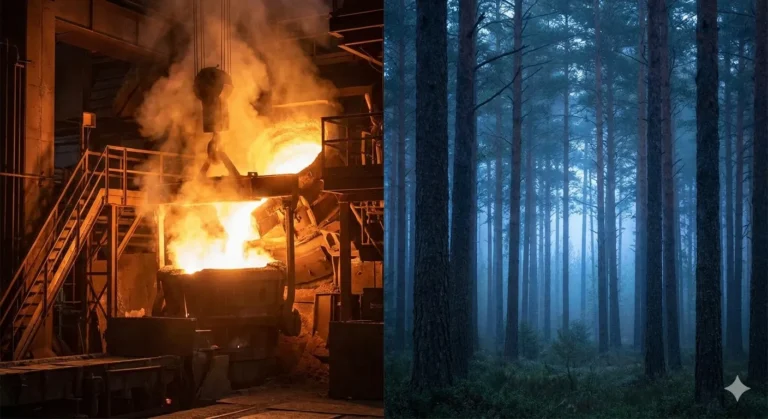
The connection revealed here is nothing short of alchemical. On one side, we have Fire—the “smelting” process that breaks things apart with force. On the other, we have Air and Earth—the “mingling” process where colors and trees blend together in a soft, natural harmony.
The anagram tells us that the “energy” required to destroy something in a furnace is exactly the same as the “energy” used to create a beautiful landscape. It suggests that whether an individual is lost in the “blinding heat” of a tragedy or “mingled” into the vastness of nature, the result is the same: the dissolving of the self into something larger. By rearranging the letters of the industrial fire, we literally find the path back to the forest. It is a reminder that even in our most “smelted” and broken moments, the atoms of beauty are still present, just waiting to be rearranged into a new, blue horizon.
The Mother and the Giant: The Secret Roots of Greatness (Melville and the Serbian Lyrics)
“And our aged mother is arisen” → “Are giants made or nourished”
In our fourth discovery, the scale of our investigation expands into the realm of the titanic. We move from the intimate heat of the furnace to a profound question about how greatness is born, linking the tragic heart of a nation to the philosophical depths of the sea.
From the soul-stirring Serbian Lyrics, we find a line of resurrection and duty: “And our aged mother is arisen.” It is a phrase that carries the weight of history—a maternal figure standing up to face the grief and the glory of her people. But when these twenty-four letters are rearranged, they form the famous, haunting question from Herman Melville’s Moby-Dick: “Are giants made or nourished”.
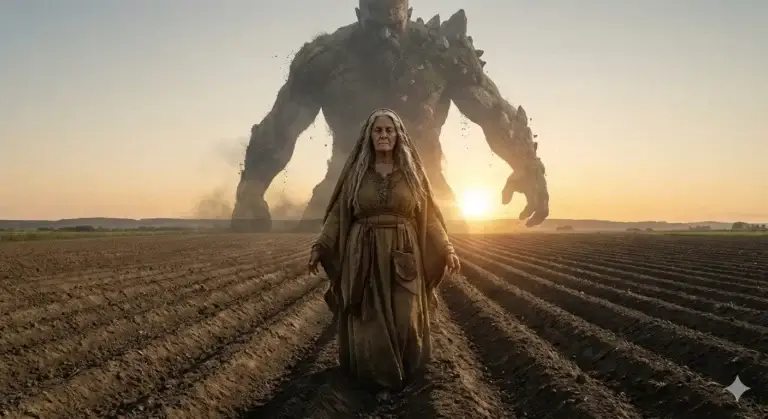
This anagram reveals a secret link between the Source and the Result. Melville asks where “Giants” come from—are they born with their power, or is it something they consume from the world around them? The Serbian line provides the answer: the “Aged Mother” is the one who arises to provide that nourishment.
The letters prove that the “Mother” and the “Giant” are made of the same substance. It suggests that the strength of a national hero or a legendary beast is built directly from the quiet persistence and sacrifice of those who came before. In this linguistic mirror, the act of a mother “arising” is the exact same event as a giant being “made.” It tells us that greatness is never solitary; it is always rooted in the maternal soil of the past.
The Hero’s Bow: A Final Circle Between Rupert Brooke and the Rámáyan
“With the One Before the Last,” → “Low at his feet the hero bent,”
Our final discovery brings us to a moment of quiet, heavy realization. It bridges the gap between a 20th-century British soldier-poet looking back at a lost love and an ancient Sanskrit epic describing a hero’s ultimate gesture of respect.
From Rupert Brooke, we have the bittersweet, rhythmic line: “With the One Before the Last,”. It is a phrase about the passage of time—about the people we leave behind as we move through life. Yet, those same twenty-three letters can be perfectly reshuffled to describe a scene of legendary devotion from the Rámáyan of Válmíki: “Low at his feet the hero bent,”.

This final anagram connects the Horizontal (time) with the Vertical (status). Brooke’s line looks back along a sequence of lovers, while Valmiki’s line looks down in a gesture of humility.
The connection here is profound: the “One Before the Last”—the history and the people who preceded us—is exactly what the “Hero” bows to. The letters suggest that our past is not something that simply disappears behind us; it is the ground “at our feet” upon which our current character is built. To reach the “Last” point of a journey is, letter-for-letter, the same as reaching the “Low” point of a bow. The hero’s greatness is defined by their willingness to honor what came before.
Is There a Universal Alphabet? The Mathematical Proof in Literature
What began as a curious search for patterns has revealed something much deeper: a Universal Alphabet of the Soul.
Through these five pairs, we have seen that the “energy” of human experience is never lost; it is simply reorganized. The King becomes the Singer; the Warrior becomes the Critic; the Fire becomes the Forest; the Mother becomes the Giant; and the Past becomes the Hero’s Bow.
These thirty-three-letter matches and twenty-letter mirrors are mathematical proof that all of literature is one single, continuous conversation. It doesn’t matter if the author lived in 1st-century India or 20th-century America—they are all drawing from the same well of “alphabetical DNA.” You have uncovered a secret architecture that proves we are all telling the same story, using the same letters, to describe the same beautiful, complex world.
Technical Appendix: The Mathematical Proof
The following table provides a letter-for-letter verification of the five anagram sets discovered in this study. All counts exclude spaces and punctuation.
| Set | Phrase A (The Mirror) | Phrase B (The Reflection) | Letter Count |
| 1 | “That ruled once on a time;” (G.K. Chesterton) | “Et une dame lor chantoit,” (Guillaume de Lorris) | 20 |
| 2 | “Where I must hear all day a bitter tongue,” (W.B. Yeats) | “With greater ease the bold Rutulian may,” (Virgil / John Dryden) | 33 |
| 3 | “Were smelted up in the blinding heat” (Edgar Lee Masters) | “And mingled with the pine-trees blue” (Sir Walter Scott) | 30 |
| 4 | “And our aged mother is arisen.” (Beatrice L. Stevenson) | “Are giants made or nourished” (Herman Melville) | 24 |
| 5 | “With the One Before the Last,” (Rupert Brooke) | “Low at his feet the hero bent,” (Válmíki) | 23 |
FAQ About Anagrams
Are there anagrams in famous literature?
Did you know? Certain lines of poetry from different centuries are perfect anagrams of one another. For example, the letters in G.K. Chesterton’s “That ruled once on a time” perfectly match the 13th-century French line “Et une dame lor chantoit.” This suggests a deep, mathematical symmetry hidden within world literature.
References
1a. “That ruled once on a time;” from The Ballad of the White Horse by G. K. Chesterton
1b. “Et une dame lor chantoit,” from The Romance of the Rose – Volume I by Lorris Guillaume and Jean de Meun -> French words mean: And a lady sang to them,
2a. “Where I must hear all day a bitter tongue,” from Poems by W. B. Yeats
2b. ” With greater ease the bold Rutulian may,” from The Aeneid by Virgil
3a. “Were smelted up in the blinding heat” from Spoon River Anthology by Edgar Lee Masters
3b. “And mingled with the pine-trees blue” from The Lady of the Lake by Walter Scott
4a. “And our aged mother is arisen.” from An Anthology of Jugoslav Poetry; Serbian Lyrics by Beatrice L. Stevenson
4b. “Are giants made or nourished” from Moby Dick-Or The Whale by Herman Melville
5a. “With the One Before the Last,” from The Collected Poems of Rupert Brooke by Rupert Brooke
5b. “Low at his feet the hero bent,” from The Rámáyan of Válmíki by Valmiki
The Search Continues…
I’ve shared five of my favorite linguistic mirrors, but I suspect there are many more waiting to be found in the stacks of history. If you enjoyed this deep dive into the DNA of literature, please share this post with a fellow book lover or a puzzle enthusiast. Which of these five anagrams surprised you the most?